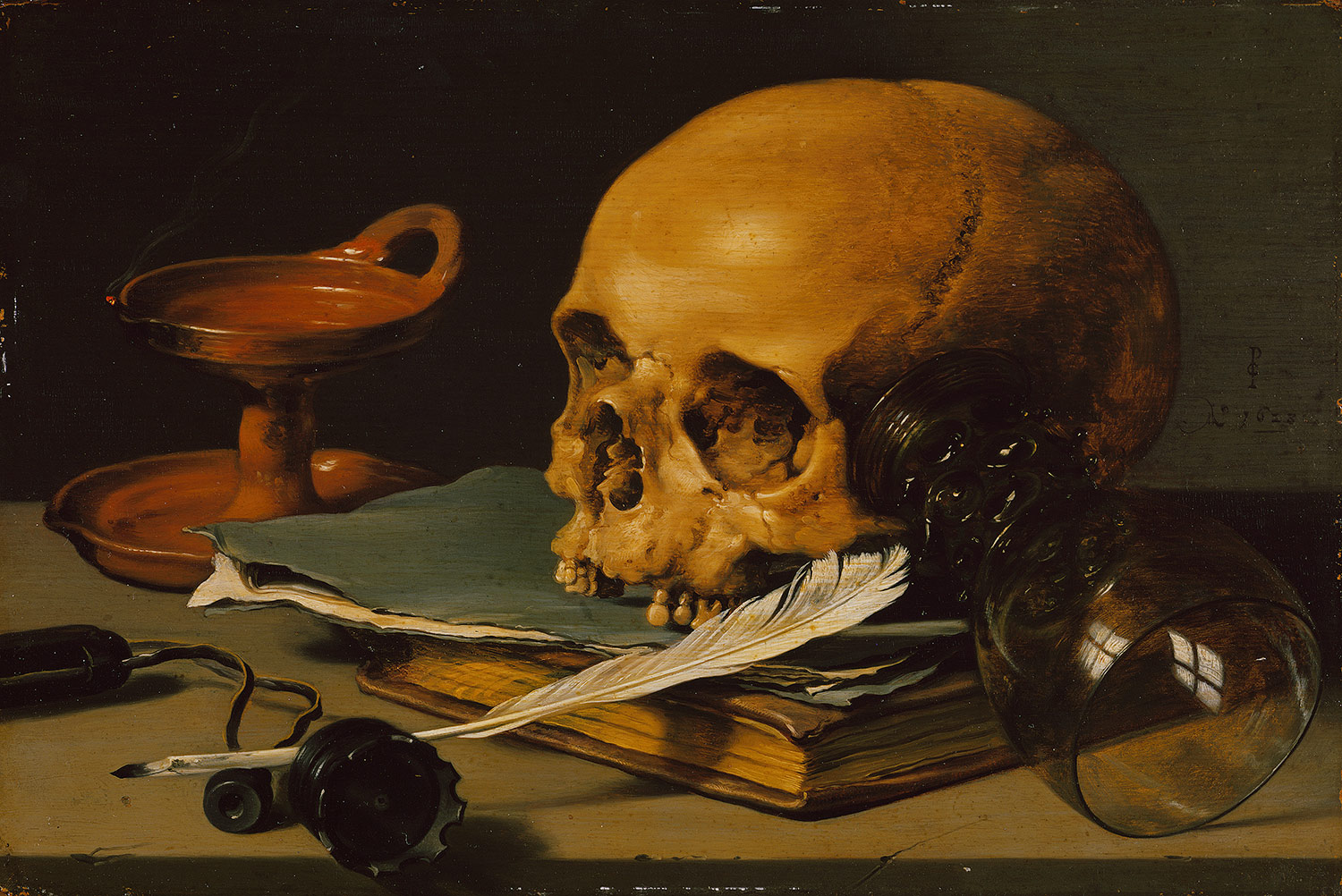
Still Life with a Skull and a Writing Quill, Pieter Claesz, 1628, Oil on Wood, 9 1/2" x 14 1/8"
1) What is the medium? Surface? Technique used?
The artist used oil paint and painted on a piece of wood. I don't know what techniques he used.
2) What are the OBJECTS or SPACE being portrayed and what is the condition of said objects/ space? What does this say about the socio-economic, age, education, religion, etc of the artist? Does the viewer need to know these things to be able to read the piece?
The objects the painter has shown are mostly easily recognized. The few things that I had a little trouble identifying where things that are not used in the form depicted anymore. I think that at the time this was painted anyone would have recognized the objects. I don't think that this composition reveals that much about the artist's background but as the viewer I don't need to know about the artist to read something in this piece.
3) What is being portrayed? What is the narrative?
All of the objects in the composition are either worn down or empty. This conveys a feeling of sadness or ending. It seems to me that something has happened to the person who was at this desk, because the lamp is almost out and the glass has been knocked over. The piece is sad because all I want to do is go in and stand things up, add more oil to the lamp and generally make is welcoming so that the person who was there will come back.
4) What are three compositional techniques used to help tell this storyline? Where is the focal point? Is there grounding? Foreground, background?
At first I wanted to say that the skull is the focal point and it still maybe, but for me the feather is the first thing I see because it is so bright compared to everything else. The feather is also placed in such a way that it leads you up to the skull and down towards the foreground and the object it is leaning against. The knocked over glass is also on a diagonal and so it also leads your eye through the composition. The glass leads you to the skull and beyond to the lamp in the background.
5) Who is the intended audience? Is this readable to a larger audience? Should the artist consider audience?
I don't know who the audience of this painting is but I don't think it makes to much of a difference because the composition is relatively simple and easy to read. The only way I can see someone having a hard time understanding this composition is if they don't know what the objects in the painting are, such as the lamp or the glass.

No comments:
Post a Comment