~ What
is painting? Are there specific tools/ surface/ media interaction
that define this act? Must it be 2-D and does it require a frame/ boundary to
exist?
According to the Merriam-Webster dictionary, painting is
"the act or act of making pictures using paint." It is not
restricted by two dimensions or by the tools used. A painter can connect to
their project up-close, like finger painting, or from a distance, like spray
paint. Traditionally, painting has been a canvas, a brush, and some paint.
Today, people can create pieces with hair dye and their own hair, and still
have it considered a “painting.”
 (Janine Antoni, Loving Care, 1993, hair dye)
Obviously, the standards are not
as strict as they once were. It seems as long as the method is similar to the
traditional form of painting it can be considered as such, be it the movements
of back and forth, or the characteristics of the medium (a liquid).
Frames or boundaries do not need
to exist. They simple add to the classification of the piece (i.e. a framed
painting versus an unframed painting). A painting is a painting whether it is
framed or not.
~ Must
painting be graphic in nature? Elaborate with at least 2 examples.
Paintings do not have to
be graphic or representational. They can be as simple as Robert Rauschenberg’s
painting:
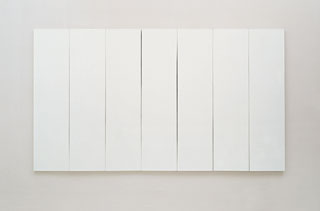 (White Painting [seven panel], 1951. Oil on
canvas, 72 x 125 x 1 1/2 inches)
(White Painting [seven panel], 1951. Oil on
canvas, 72 x 125 x 1 1/2 inches)
Or
as straight-forward as Guercino’s Aldrovandi
Dog, oil, 1625: 
Or
as busy as the famous No. 5 by
Jackson Pollock, 1948:
 .
.
~ Does
the act of painting necessarily result in a painting? Are the two mutually
inclusive? Explain.
I do not think the
physical act of painting makes a painting. It is also an idea that must go
behind a piece that makes it art. I just painted a bench a week ago, and I do
not consider it a painting or a work of art. The same goes for painting a
building or a fence. If the act is done without the intention of making it art,
it should not be considered as such. The act of painting and the creation of a
painting are two separate things.
~ Does
painting serve as the basis for other forms of art or stand on its own? Does it
matter that we make a distinction?
I believe painting stands on its
own as a form of art. It includes so many forms within itself. For example,
there are the traditional canvas paintings, 3D painting, graffiti painting, and
installation paintings. Distinction is necessary for technical characteristics
and records, but the distinction does not affect the meanings behind the art.
~ Find
three examples you feel best exemplify PAINTING with captions (artist, medium,
date, size) and an explanation on WHY you chose these.
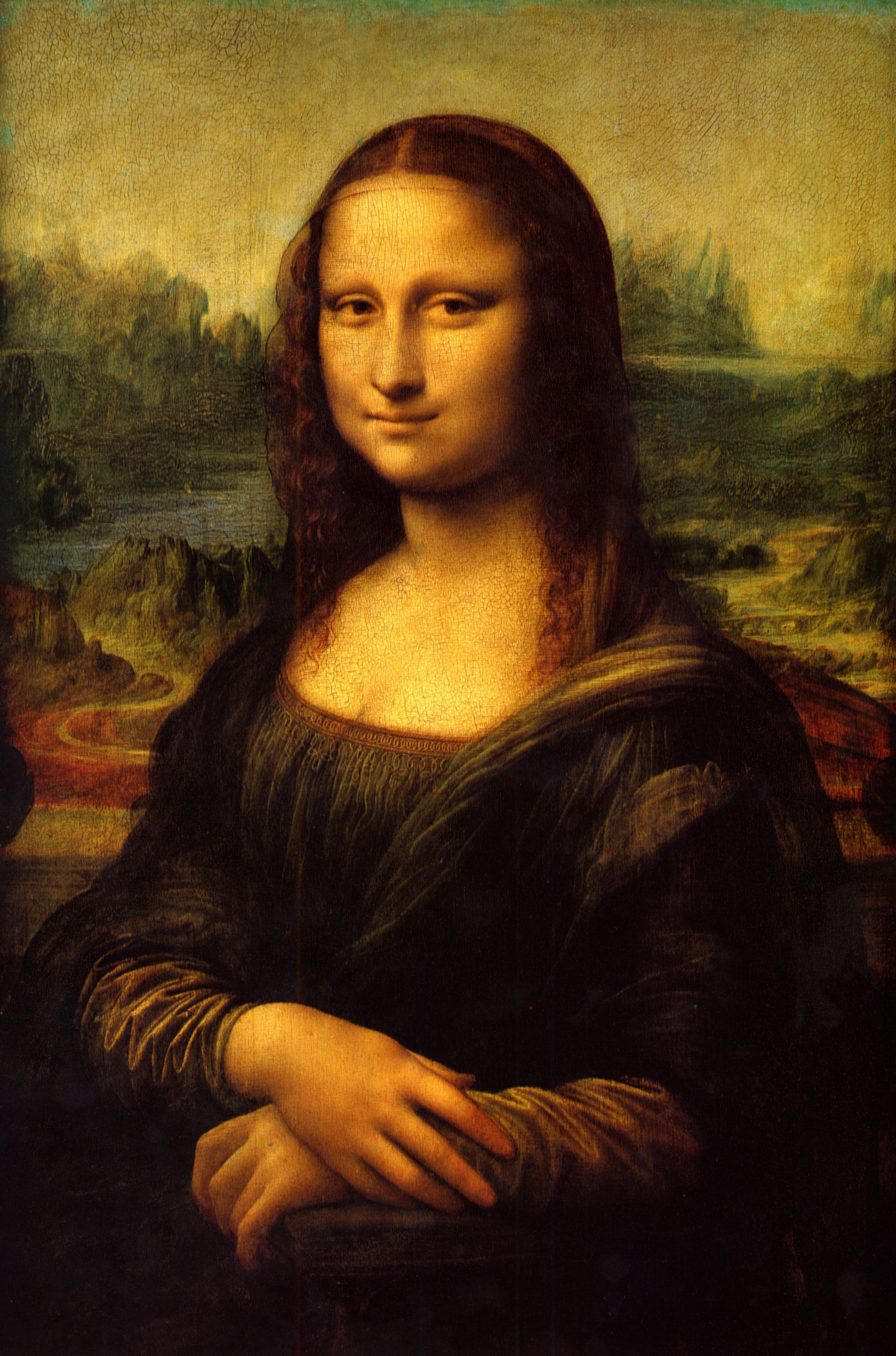 (Leonardo de Vinci, The Mona Lisa, 1503-05, oil, 30.2 x 20.9 in)
 (Liu
Bolin, Hiding in the City No.16 and No.
17 – People’s Policeman, 2006, camouflage painting)
(Liu
Bolin, Hiding in the City No.16 and No.
17 – People’s Policeman, 2006, camouflage painting) (Ian Davenport,
Puddle Painting, 2009, acrylic paint on stainless steel, mounted
on aluminum panel, 98 1/2 x 98 1/2 inches)
(Ian Davenport,
Puddle Painting, 2009, acrylic paint on stainless steel, mounted
on aluminum panel, 98 1/2 x 98 1/2 inches)
I
choose these three paintings because of the genres they represent: tradition,
3D, and installation, respectively. The Mona
Lisa is what most people think of when thinking about painting. The other two
are modern takes on painting and may even be questioned on being so. I consider
each of these to belong to the painting group.

No comments:
Post a Comment